




D2C implementation on Magento 2 for manufacturers and private-label brands
Aurora Creation designs and delivers D2C platforms on Magento 2 for manufacturers and private-label brands that want to sell directly to end customers. The scope covers the sales model, the buying experience, integrations and the processes needed to launch and grow the channel.
We start from the way the company works. We establish where product, price and stock data comes from, how orders should be handled, and which parts of the buying experience need an individual approach.
- D2C model analysis
- Magento 2
- system integrations
- a dedicated Project Manager
- QA and code review
- 18 years of e-commerce experience
- 100+ Magento implementations and major projects
- Hyvä Bronze Partner (opens in a new tab)
In a D2C model the manufacturer takes over the whole sales process to the end customer
D2C (direct-to-consumer) is the model in which a manufacturer or a brand sells straight to the end customer, with no traditional distributor or retail network in between. When selling through distributors, part of the process happens outside the manufacturer's organisation; in its own D2C channel the company is responsible for the offer, prices, payments, deliveries, returns, customer service and the development of the buying experience.
The store has to be connected to the company's operations. Product information can come from a PIM or an ERP, stock from the warehouse, the order goes to fulfilment, and customer data is passed to the right marketing and analytics tools.
Dependencies that are not clearly described lead to manual work fast. The team updates the same data in several places, resolves exceptions outside the system, and every change requires another round of technical agreements.
- 01
Offer and brand
The catalogue structure, product content, variants, prices, promotions and the way the brand is presented all have to match the rules of sale.
- 02
Purchase process
Search, the product page, cart, payments and deliveries should match the way the customer chooses and buys the product.
- 03
Order fulfilment
Magento 2 exchanges data with the warehouse, the ERP, payment providers and the companies responsible for delivery.
- 04
Data and channel growth
Data on customer behaviour supports the offer, marketing, after-sales service and the planning of new features.
Should the platform also serve wholesale customers? See the scope of a B2C + B2B implementation on Magento 2.
How do you launch D2C alongside selling through distributors?
A manufacturer that already has a sales network does not start from a blank page — it starts from the question of what the new channel does to the existing one. The answer is a commercial policy, not a feature of the store.
Channel conflict rarely comes from the mere existence of a manufacturer's store. It comes when the distributor learns from their own customer that the brand sells cheaper, faster or with better availability. That is why the rules below are settled before the build, and only then turned into Magento 2 configuration.
Pricing policy
Does the manufacturer's store hold the recommended price or go below it? Most often D2C stays at the list price, and the channel's advantage is availability and service rather than a discount. In Magento 2 that is written as pricing rules and customer groups, not as manual exceptions.
Promotions and sales
The promotion calendar covers both channels or only one. If a campaign is D2C only, the distributor should know about it in advance — that is usually cheaper than explaining it afterwards.
Product availability
The manufacturer's store can sell from the same stock pool as distribution or from a separate one. That decides which channel wins when stock runs low, and it has to be reflected in the ERP or WMS integration.
Differences in the range
Some manufacturers separate the channels by assortment: personalisation, bundles, limited editions and made-to-order products go to D2C, while volume stays with distribution. The conflict then largely disappears, because the channels are not selling the same thing.
Returns and complaints
A D2C order comes back to the manufacturer, not to the shop the customer used before. Support, the warehouse and finance have to recognise the return path and know who carries its cost.
Data and the channel's advantage
The direct channel gives the manufacturer what distribution does not hand over: data about the customer, their path to purchase and the reasons they drop out. For many brands that is a stronger argument for D2C than the margin.
These decisions are written down together with the sales model in the analysis before implementation. The configuration of prices, stock and returns in Magento 2 follows from them, not the other way round.
Magento 2 makes sense when the D2C channel has to serve a complex sales model
The size of the company is not the only criterion. The catalogue, the sources of data, the number of integrations, the way orders are fulfilled and the plans for the channel matter just as much.
Magento 2 fits when
- 01the catalogue involves many variants, attributes or product dependencies
- 02prices and promotions require elaborate rules
- 03products, stock and orders are handled by several systems
- 04the purchase process needs industry-specific features
- 05the company plans further brands, store versions or markets
- 06sales, marketing, logistics and IT teams need different levels of access
- 07the D2C channel is meant to carry a large share of revenue and will be developed regularly
Another option may be more sensible when
The store is to run in a single market, the catalogue is simple, the purchase process stays standard and there are few integrations. In such a project a D2C implementation on Shopify can reduce the cost of launching and running it later.
With a closed scope for a Magento 2 build it is also worth checking AURORA ONE. It shows whether the project fits a more standardised delivery model.
The most expensive mistakes are made before implementation work starts
Incomplete requirements come back during delivery as scope changes, additional integrations and the rebuilding of features that had already been accepted. That is why the key business and technical decisions have to be closed before work begins.
A project cannot be estimated accurately from a list of screens. The areas below show what we establish in conversations with the people responsible for e‑commerce, sales, logistics and IT.
- 01
Sales model
- Which products are to be sold directly?
- Will prices and promotions differ from the other channels?
- How will the D2C channel affect cooperation with distributors?
- Who owns the offer and the commercial policy?
ResultA description of the sales model and the rules Magento 2 has to support.
- 02
Customer and purchase process
- How does the customer search for and compare products?
- What information do they need before buying?
- Does the product require configuration, guidance or a consultation?
- How should the cart, payment, delivery and customer account work?
ResultThe scope of the buying experience and of the main user journeys.
- 03
Products and data
- Where are descriptions, attributes, images and prices created?
- Which system is the source of stock levels?
- How often should data be synchronised?
- Who is responsible for data quality before launch?
ResultA map of data sources and of the rules for their flow.
- 04
Order fulfilment
- Where does the order go once it has been paid for?
- What do picking, shipping, cancellation and returns look like?
- Which statuses are passed on to the customer?
- How are exceptions handled?
ResultThe order fulfilment process together with the responsibility of systems and teams.
- 05
Initial scope and growth
- What has to be in the first version?
- Which features can be built later?
- Which brands, channels or markets are planned?
- Which architectural decisions depend on that roadmap?
ResultThe scope of the implementation, a backlog for further growth and the acceptance criteria.
The analysis can also be commissioned as a separate stage: pre-implementation analysis.
The scope covers the store and the processes it needs to run
The final scope follows from the analysis. The areas below show which elements most often have to be designed, connected and tested when launching D2C sales on Magento 2.
- 01
Analysis and architecture
We describe the sales process, the data sources, the roles of the systems and the dependencies between teams. That is the basis for the scope and the architecture of the implementation.
Example elements
- the customer journey from arrival to after-sales service
- the roles of Magento 2, ERP, PIM and WMS
- the scope of integrations
- functional requirements
- acceptance criteria
- the launch plan
- 02
UX, design and frontend
We design a buying experience that matches the nature of the product, the brand and the way the customer makes decisions.
The work can cover information architecture, search, categories, the product page, cart, checkout, the customer account and the elements that support product choice. The frontend also accounts for performance, accessibility and room for further development.
- 03
Catalogue and product data
We establish the category structure, attributes, variants, media, product relations and the rules for managing content.
Data can be entered in Magento 2, imported, or synchronised from an ERP or a PIM. The source of every piece of information should be agreed before the integration is built.
- 04
Purchase, payments, deliveries and returns
We configure the process from adding a product to the cart through to handing the order over to fulfilment.
The scope depends on the way you sell, the payment methods, the logistics operators, the delivery rules and the returns process. Non-standard scenarios are described before work starts.
- 05
Integrations and automation
Magento 2 can exchange data with an ERP, PIM, WMS, CRM, marketing systems, payment providers and delivery services.
For every integration we establish
- the source of data
- the direction of exchange
- the frequency
- the response to an error
- the responsibility of each system
- how it is tested
- 06
Testing, launch and project handover
The implementation goes through functional and technical testing. The client's team gets an environment to check its business processes before launch.
The scope also covers the production rollout plan, access to the project, documentation and an agreement on who is responsible after go-live.
ERP, PIM and WMS have to exchange data with Magento under clear rules
Saying that the store will be integrated with an ERP does not yet describe a solution. You have to establish which system is the source of the data, when synchronisation happens and what happens when an error occurs.
Magento 2 can pull product data from a PIM, prices and commercial information from an ERP, and stock from the warehouse system. After a purchase the order goes to fulfilment and the customer receives up-to-date statuses.
In a different model some of the data can be managed directly in Magento. That decision depends on the current architecture, the responsibilities of the teams and the quality of the information available in the company's systems.
The architecture diagram is prepared for a specific project, together with the direction of exchange, the frequency and the response to errors. The list above shows the flows we most often establish for D2C sales.
The flows we most often establish
PIMMagento 2
- names and descriptions
- attributes
- media
- product relations
ERPMagento 2
- prices
- taxes
- commercial data
- availability
WMSMagento 2
- stock
- reservations
- fulfilment status
Magento 2ERP and WMS
- orders
- payments
- customer data
Magento 2CRM and marketing automation
- consents
- activity
- purchase history
Payment and delivery providersMagento 2
- payment status
- shipments
- deliveries
We split the project into decision points and acceptance stages
Each piece of work starts once the decisions it depends on have been closed. That surfaces gaps earlier, keeps scope changes under control and lets the project be accepted in stages.
- 01
Conversation and qualification
We get to know the sales model, the current situation, the planned scope, the systems and the expected business deadline. At this stage we assess whether Magento 2 fits the project.
- 02
Pre-implementation analysis
We describe the processes, data, integrations, requirements and risks. The conversations involve the people responsible for e‑commerce, sales, logistics and IT.
- 03
Scope and architecture
The project is split into areas, dependencies and stages. We also agree the acceptance criteria and the responsibilities on both sides.
- 04
Design and delivery
UX, design, Magento 2 development and the integrations are built according to the approved scope. Changes are discussed along with their effect on budget and schedule.
- 05
Testing and acceptance
QA checks the features and the critical scenarios. The client's team tests its business processes on a prepared environment and raises comments before launch.
- 06
Launch and further growth
A production rollout plan is prepared before the start. After go-live the project moves into the agreed model of monitoring, maintenance and development.
After go-live
Maintenance and growth after a D2C implementation
Monitoring, updates and error handling can be delivered under AURORA CARE. Planned development work we deliver in the AURORA EVOLUTION model, where every task gets its own scope and price.
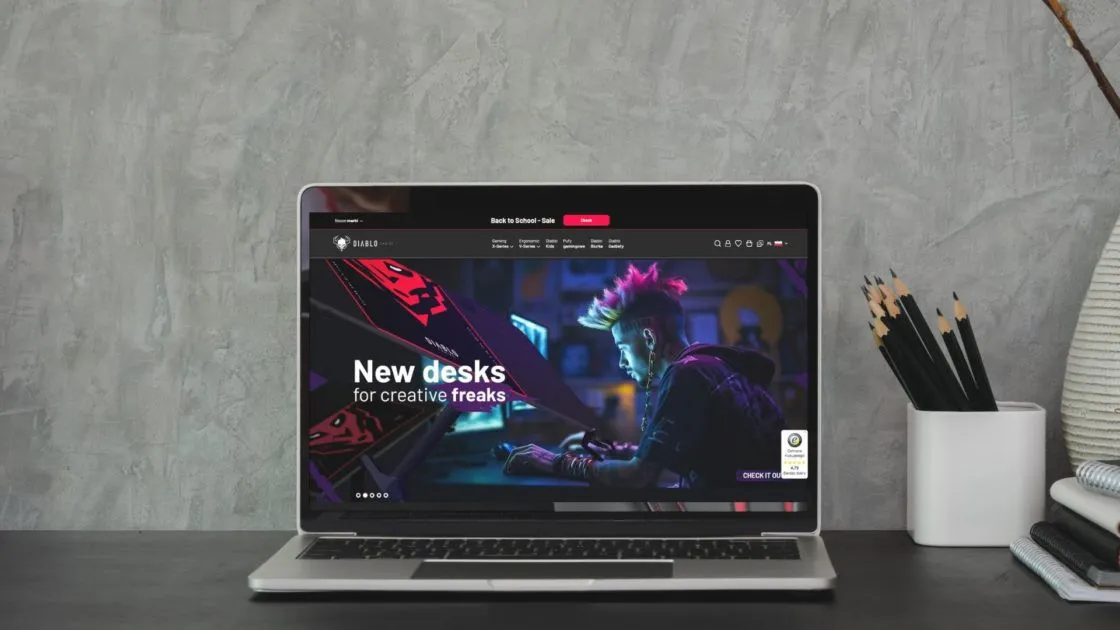
D2C on Magento 2 in practice — Diablo Chairs across 30 store views
Diablo Chairs runs D2C sales across many markets from a single Magento 2 environment. The platform covers 30 store views, 12 language versions and separate sites for the Kido and Brave brands.
- Sales model
- D2C sales run in parallel across many international markets, together with separate sites for the group's brands.
- Scope
- Delivery of a Magento 2 platform serving market, language and brand versions within one architecture.
- Architecture
- One Magento 2 instance covering 30 store views and 12 language versions.
- Operational effect
- Each additional market version uses the shared code, integrations and admin panel instead of a separate platform per country.
- 30store views
- 12language versions
- 1Magento 2 instance
See how we designed a Magento 2 architecture for managing many markets and brands.
See the Diablo Chairs case studyCost and timeline depend on decisions made before the work starts
Changes are a normal part of an e‑commerce implementation, but we limit their impact by spotting dependencies early enough and deciding before the next tasks begin.
Risk
How it is reduced
- Unclear scope
- How it is reducedProcesses, requirements and acceptance criteria are described before development. New needs get a separate assessment of their effect on scope, cost and schedule.
- Risk on the integration side
- How it is reducedBefore the actual work starts we check the documentation, the availability of environments and the quality of the data. Error scenarios are part of the integration design.
- Quality of code and features
- How it is reducedWork goes through QA and code review. Features are tested on a pre-production environment before they are moved to production.
- Dependence on the supplier
- How it is reducedDocumentation, access to the code, the history of tasks and the option of a direct technical conversation limit the situations where knowledge of the platform sits with one person only.
- Launch
- How it is reducedThe start has a checklist, a rollout plan, a split of responsibilities and a way of responding to errors. After go-live the platform needs monitoring and an agreed support model.
Monitoring and maintenance after the start are described in the AURORA CARE service.
Frequently asked questions about D2C implementation on Magento 2
The answers cover the scope of the service, the integrations and the conditions that determine the cost, the timeline and the way a D2C channel is launched.
Let's discuss your D2C implementationIt is the design and launch of a sales platform through which a manufacturer or a private-label brand sells directly to end customers. The project can cover Magento 2, the frontend, the catalogue, the purchase process, payments, deliveries, integrations, testing and launch preparation. The 4Szpaki store was built that way. The standard features of the platform itself can be checked in the Magento 2 demo.
B2C describes who you sell to — an individual consumer. D2C describes who is selling: the manufacturer or the brand owner, directly, with no distributor or retail network between them and the customer. Every D2C store is therefore a B2C store, but a B2C store run by an intermediary is not D2C. The difference has practical consequences: in D2C the manufacturer answers for the price, the availability, the delivery, the return and the customer data.
Yes, and that is what most projects look like. The condition is settling the pricing policy, the promotion calendar, product availability, any differences in the range and the handling of returns before the build starts. The rules that have to be closed are set out in the section on launching D2C alongside distribution.
Magento 2 is a good candidate for an extensive catalogue, numerous integrations, an individual purchase process, or plans covering several brands, stores or markets. For a simpler model it is worth comparing it with a D2C implementation on Shopify.
Integrations can be part of the project scope. Their exact extent depends on the systems, the interfaces available, the quality of the data and the responsibility of each application.
Not in every project. Whether a PIM is needed depends on the size of the catalogue, the number of channels, the way content is produced and the quality of the data available in the ERP and other systems.
Yes, but it requires designing different processes, customer roles, prices and commercial terms. We describe that option on a separate page about the B2C + B2B implementation on Magento 2.
Usually not. Magento 2 does not have to replace the ERP or take over its functions — it has to exchange data with it under clear rules: which system is the source of products, prices and stock, when synchronisation happens and what happens when an error occurs. Changing the ERP only becomes a subject when the current system has no interface to integrate with, or cannot handle orders from a direct channel.
Yes. Another brand can run as a separate site with its own domain, catalogue and sales configuration, inside the same Magento 2 instance. That is how Diablo Chairs works, where the main store stands beside separate sites for the Kido and Brave brands.
Yes. The Magento Multistore architecture lets you add further markets, language versions and local sales configurations inside one platform. Adding a market in a fixed scope at a fixed price is delivered as AURORA CROSS. It is worth assuming that path while the architecture is being designed, because separating markets later costs more than planning for it up front.
The cost depends among other things on the scope of UX, the catalogue, the integrations, individual features, the data and the planned architecture. An estimate is prepared once those elements have been established.
The schedule is prepared after the scope and the dependencies have been analysed. Integrations, data availability, the number of features and the time the client's team needs for decisions and acceptance all have a strong effect.
Yes, provided the scope of the first version and the further roadmap are known while the architecture is being designed. That makes it possible to postpone some features without blocking the later stages of growth.
After the start the platform needs monitoring, updates, error handling and planned development. Further cooperation can be based on AURORA CARE or AURORA EVOLUTION, depending on the kind of need.
Have a question about your own project? Let's discuss it on a call.
Let's check whether Magento 2 fits your planned D2C channel
Tell us about your sales model, your current systems and your growth plans. On the first call we will establish what information is needed to assess the scope and whether Magento 2 is the right direction.

What to expect after sending your enquiry
- 1Contact within 1 business day and follow-up questions about the sales model and the company's systems.
- 2A conversation about the purchase process, the product data and order fulfilment.
- 3An answer on whether Magento 2 fits the project and what data is needed to prepare a scope.
Enquiry sent
Thank you, we'll get back to you within 1 business day.
The enquiry has not been sent
We have marked the fields that need filling in or correcting.