



AURORA ONEMagento 2 with a Hyvä frontend in a fixed scope and a fixed price.D2C implementation on Magento 2A platform for a manufacturer or brand that wants to sell directly to consumers.B2C + B2B implementation on Magento 2One shared architecture for retail and business sales with separated terms.B2B implementation on Magento 2A purchasing platform for distributors, wholesalers and business customers.
Magento 2 for manufacturers and brands growing their online sales
Aurora Creation is a Magento 2 agency that designs, implements, takes over and grows e‑commerce platforms for manufacturers and brands. We deliver B2C, B2B and D2C implementations, migrations of existing stores, takeovers of projects already under way, and integrations with ERP, PIM, WMS and other business systems.
- New implementations
- Migrations
- Growth and maintenance
- B2C, B2B and D2C
- Multiple markets
- Integrations
- 18 years of e-commerce experience
- 100+ Magento implementations and major projects
- Hyvä Bronze Partner (opens in a new tab)
What is Magento 2 and which kind of e‑commerce does it suit?
Magento 2 is an open-source e‑commerce platform on which a store is built around a company's own sales processes rather than around a ready-made template. It handles B2C, B2B and D2C sales, several brands and markets in one instance, and the exchange of data with the company's systems.
The platform is not decided by turnover but by the way sales work: the number of customer groups, markets, commercial rules and integrations. Magento 2 is worth considering when an off-the-shelf platform starts to constrain those processes or raises the cost of every further change. For a simple store running on a single market, a SaaS platform may be the better choice.
Read what Magento 2 isWhat the platform handles, as standard and once extended
- B2C, B2B and D2C sales models within one architecture,
- several brands, countries, languages and currencies in one instance,
- large catalogues with custom product types and attributes,
- price lists, discounts and commercial terms per customer group,
- integrations with ERP, PIM, WMS, CRM and sales channels,
- custom development of processes the standard does not cover.
Magento 2 is worth considering when
- the company serves several customer groups and different commercial terms,
- B2C and B2B sales are meant to run within one shared architecture,
- more brands, countries, languages or currencies are planned,
- the store exchanges data with ERP, PIM, WMS, CRM or a marketplace,
- the purchase process goes beyond the standard of an off-the-shelf platform,
- e‑commerce accounts for a significant part of the company's revenue.
A simpler platform may be enough when
- sales run on a single market,
- the catalogue and checkout use standard features,
- the store has few integrations,
- the company is not planning separate B2B processes,
- the priority is launching a simple channel quickly.
If that is closer to your situation, see our Shopify services.
Magento Open Source or Adobe Commerce — which edition to choose?
Both editions stand on the same foundation. What separates them is the licensing model and the range of features that ship with the product, so the decision should follow from the cost of implementing and maintaining the processes you need, not from the licence price alone.
| Area | Magento Open Source | Adobe Commerce |
|---|---|---|
| Product model | Open code, developed and published by Adobe. | A commercial platform built on the same technology. |
| Licence fee | No standard fee for using the platform. | A commercial licensing model. |
| Extended B2B processes | Usually need modules or custom code. | Available through the Adobe Commerce B2B extension. |
| When to consider it | When the scope of your needs can be met with modules and development. | When the ready-made features genuinely replace custom solutions. |
Product model
Magento Open Source
Open code, developed and published by Adobe.
Adobe Commerce
A commercial platform built on the same technology.
Licence fee
Magento Open Source
No standard fee for using the platform.
Adobe Commerce
A commercial licensing model.
Extended B2B processes
Magento Open Source
Usually need modules or custom code.
Adobe Commerce
Available through the Adobe Commerce B2B extension.
When to consider it
Magento Open Source
When the scope of your needs can be met with modules and development.
Adobe Commerce
When the ready-made features genuinely replace custom solutions.
The edition with no licence fee can turn out more expensive if the company has to rebuild and then maintain extensive processes for years. Adobe Commerce can be hard to justify when most of its capabilities will go unused. We settle the edition during analysis, together with the scope of the implementation.
Compare both editions in detailMagento 2 services — implementation, migration, growth and maintenance
A company building a new D2C channel needs a different path than a team taking over a live store, and different again from a brand preparing to expand abroad. Choose your starting point. You'll find the detailed scope, the process and examples of our work on the relevant service subpage.
How much does a Magento 2 implementation cost, and how long does it take?
A price cannot be given without a scope, but what makes up that price can. These are the factors that most often decide the budget and the timeline.
Price and timeline are driven mainly by
- the number and complexity of integrations with ERP, PIM, WMS and CRM,
- the scope of the data migration and the state of the data in the current system,
- custom UX and features beyond the platform's standard,
- the number of markets, language versions and currencies,
- the sales model: B2C, B2B, D2C or a combination of these,
- the chosen edition of the platform and the scope of frontend work.
Implementation in a closed scope
PLN 39,000net
1–3 monthsplanned delivery time
That is the price of AURORA ONE — a standard Magento 2 implementation with a Hyvä frontend for a project that fits a prepared scope. Requirements beyond that scope are priced separately, after the project is qualified.
Magento 2 with a Hyvä frontend
Hyvä is a frontend for Magento 2 that replaces the default theme with lighter code. The store loads less JavaScript, and the team ships changes to the customer-facing layer faster.
In Aurora Creation's projects Hyvä is the default choice for new implementations and for rebuilding the frontend of a live store. SklepBaterie.pl runs on it, and implementations in the AURORA ONE model are built on it by design.
Hyvä does not change Magento's backend: the catalogue, prices, cart and integrations work the same way. It changes how the presentation layer is built, so the decision is made together with the scope of frontend work, not after it.
See a Magento 2 implementation with HyväWhat Hyvä changes in a project
- a lighter frontend and less code to maintain,
- shorter turnaround on changes to the presentation layer,
- a custom design without working around the default theme,
- a lower cost for further work on the store's appearance.
Hyvä Bronze Partner
Aurora Creation is an official Hyvä partner at Bronze level and designs Magento 2 stores using this frontend.
ERP, PIM, WMS and sales channels must work on shared data
A manufacturer's store rarely works alone. Products, prices, stock, customers and orders are exchanged between Magento, ERP, PIM, WMS and the sales channels. An error in that flow can mean an out-of-date price, a sale of a product that is not available or a wrong order status.
Before work starts we establish which system is the source of each kind of data, in which direction it should be sent and what should happen in the event of an error. Magento 2 can hold the central sales role, but it should not take over functions that belong to ERP, PIM or WMS.
An integration design answers questions such as:
- where Magento pulls products, descriptions and media from,
- where prices, discounts and commercial terms are created,
- which system holds stock levels,
- where orders go after purchase,
- how fulfilment statuses are synchronised,
- how errors and delays are handled,
- who is responsible for each side of an integration.
The scope of a Magento 2 project follows from sales processes, data and integrations
A feature list prepared before analysis usually does not show the full scope of a project. First we establish what the company sells, to whom, on which markets and under what rules. Only then do we assess whether a new implementation, a migration, a project takeover, growth or maintenance is needed.
- 01
Sales model
We establish whether the platform is to handle D2C sales, B2B, several brands, several countries or a combination of these models.
- 02
Current situation
We review the platform, data, integrations, code and infrastructure. For a new project we analyse the data sources and the way the team works.
- 03
Architecture
We define the roles of the systems, the data flows, the modifications needed, the performance requirements and how it will be maintained.
- 04
Choosing the right service
We point out whether the project needs a new implementation, a migration, a takeover of work already started, expansion into further markets, growth or maintenance.
- 05
Scope and delivery
You receive the scope of work, the split of responsibilities, the pricing model and a plan for moving from the current situation to launch or the next stage of growth.
Magento 2 implementations in practice — case studies
Three different kinds of project on the same platform: cross‑border sales, a project takeover with the migration of a large catalogue, and an implementation joining B2B and B2C.

D2C implementation and cross‑border sales
Diablo Chairs
A D2C platform on Magento 2 serving sales across many markets from a single environment, along with separate sites for the Kido and Brave brands.
30store views
12languages
1Magento 2 instance

Migration and project takeover
SklepBaterie.pl
Taking over a build already started, migrating the catalogue from CS Store and launching Magento 2 with a Hyvä frontend.
181 000products in the catalogue
91%of URLs preserved
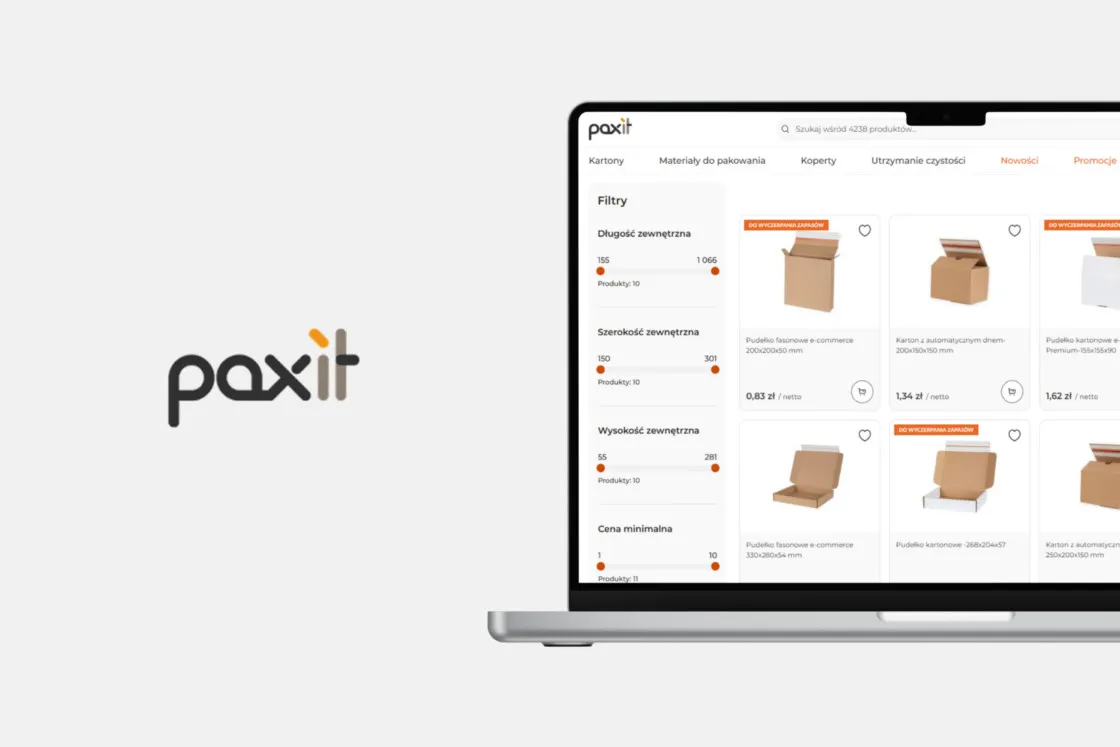
B2B and B2C implementation
Paxit
A new store on Magento 2 with B2B features, integrations with an ERP system and external tools, and checkout completed on a single page.
See the Paxit case studyWith Magento, responsibility spans architecture, code and maintenance
Problems in Magento most often arise at the boundary of the application, integrations and infrastructure. That is why, before work starts, we establish the owner of each area, how a fault is responded to and the path decisions take.
01
Architecture and integrations
Dependencies between systems are described before development. The team knows where data is created and how it should flow before the first line of code is written.
02
Project Manager and communication
Scope, priorities and progress are run at an agreed rhythm. The e‑commerce manager does not have to coordinate several specialists on their own.
03
QA and code review
A change is checked before it goes to production. The scope of testing depends on the risk and the impact of the feature on sales.
04
Monitoring, SLA and hosting
After launch we establish monitoring, incident response, security updates and the boundaries of responsibility for the application and the infrastructure.
FAQ — Magento 2, implementation and growth
Answers to the questions that keep coming back before a platform is chosen and before a project is priced. We describe the details of implementation, migration, growth and maintenance on the service subpages.
The price depends on the scope of integrations, the data migration, the number of markets and how much custom development is needed. The reference point is AURORA ONE: PLN 39,000 net for a standard Magento 2 implementation with a Hyvä frontend. Projects that go beyond that scope are priced after analysis.
A standard implementation in the AURORA ONE model is planned for 1–3 months from the moment the materials are complete and the project start conditions are met. An implementation with extensive integrations, a large catalogue migration or many markets takes longer — we confirm the date once the scope is settled.
Both editions share the same foundation. Open Source has no standard licence fee, but extended B2B processes there need modules or custom code; Adobe Commerce ships them as product features under a commercial model. What decides is the total cost of implementation and maintenance, not the licence alone — we compare both editions in the article what Magento 2 is.
Shopify works well with a simpler catalogue, one market and a standard purchase process. We choose Magento 2 when a store has to handle several customer groups, its own commercial rules, many markets or extensive integrations. Magento's catalogue, cart and admin panel can be checked in the Magento 2 demo.
Yes. The platform handles company accounts, separate price lists and commercial terms, user permissions on the customer's side, and purchase processes that go beyond a standard cart. The range of features depends on the edition and on the company's processes — we describe it on the B2B implementation on Magento 2 page.
Yes. Retail and business sales can run within one architecture, with price lists, permissions, purchase paths and billing kept separate. That is how the Paxit store works; the scope of such a project is described in B2C + B2B implementation on Magento 2.
Yes. A single instance can serve many store views, languages and currencies. In the Diablo Chairs project that means 30 store views and 12 languages in one environment. Adding another market to a running store is delivered as AURORA CROSS.
Yes, provided the responsibilities of the systems and the data flow are designed. Before pricing we establish the data sources, the scope of synchronisation, the exchange frequency and how errors are handled.
Yes. Hyvä replaces Magento 2's default theme with lighter code and is our default choice for new implementations and for rebuilding the presentation layer. Aurora Creation is an official Hyvä partner at Bronze level, and an implementation with this frontend in a closed scope is delivered as AURORA ONE.
Yes. A takeover starts with an analysis of the code, infrastructure, integrations, documentation and current problems. On that basis we build a plan for stabilisation, finishing the build, maintenance or further growth.
After launch the platform needs monitoring, security updates, response to failures and planning for further growth. That work can be covered by AURORA CARE, AURORA EVOLUTION and Magento 2 hosting. Materials about the work after launch are collected in the Magento Knowledge Centre.
Let's talk about your e‑commerce
Describe your current platform, your sales model and the most important change you are planning. In the first call we'll establish the starting point and the scope of the analysis that follows.
We'll go through the current blockers, the systems connected to the store and the planned direction of growth. You don't need to know which service you need.

[email protected]ul. Jana Henryka Dąbrowskiego 28, 15-872 Białystok, Poland
Enquiry sent
Thank you, we'll get back to you within 1 business day.
The enquiry has not been sent
We have marked the fields that need filling in or correcting.